Gurudwara
Connaught Place, New Delhi
Delhi 110001
Delhi
India
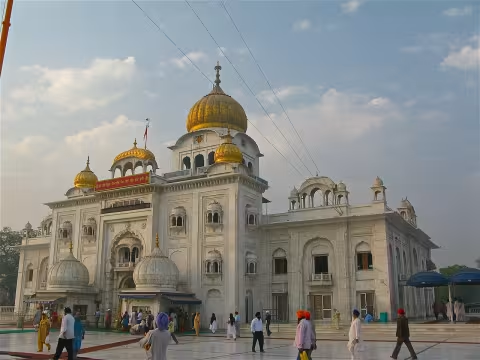
Gurdwara Bangla Sahib
Gurdwara Bangla Sahib is one of the most prominent Sikh gurdwaras, or Sikh house of worship, in Delhi, India, and known for its association with the eighth Sikh Guru, Guru Har Krishan, as well as the holy pond inside its complex, known as the "Sarovar." Originally a bungalow of Raja Jai Singh I of Amber, it was rebuilt as a small shrine by Sikh General Sardar Baghel Singh in 1783. In the same year, there was reconstruction of nine Sikh shrines in Delhi.
History
Gurdwara Bangla Sahib was originally the bungalow of Raja Jai Singh, a Hindu Rajput ruler in the 17th century. When Guru Har Krishan visited Delhi, Raja Jai Singh offered him this residence. During his stay, Guru Har Krishan devoted himself to serving the sick and poor, instructing that offerings be used for charity. He passed away in Delhi in 1661, and Jai Singh later built a small tank over the site’s well, whose waters are still considered sacred. Since Guru Har Krishan stayed at this bungalow (called bangla locally), the place was converted into Gurdwara Bangla Sahib to honor his memory. Today, the gurdwara and its Sarovar are an important place of worship for Sikhs, especially on Guru Har Krishan’s birth anniversary. The complex includes a large Sarovar, hospital facilities, a diagnostic center offering affordable care, a Khalsa Girls School, and a museum named after Baghel Singh. During the 1984 anti-Sikh riots, many Sikhs took refuge inside the gurdwara, highlighting its role as both a spiritual and protective sanctuary.
Near Parliament House in New Delhi.
New Delhi 110001
Delhi
India
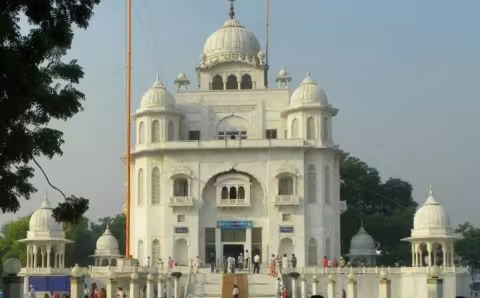
Gurdwara Rakab Ganj Sahib
The Gurdwara Rakab Ganj Sahib is a historic gurdwara near Parliament House in New Delhi. It was built in 1783, after Sikh military leader Baghel Singh (1730–1802) captured Delhi, on 11 March 1783, and his brief stay in Delhi led to the construction of several Sikh religious shrines in the city. This one marks the site of cremation of the ninth Sikh Guru, Guru Tegh Bahadur, after his martyrdom in November 1675 for helping Kashmiri Hindu Pandits, under orders of the Mughal Emperor Aurangzeb. The Gurudwara Sahib is built near old Raisina village near Raisina Hill, at present Pandit Pant Marg, took 12 years to build. Prior to that, a mosque had been built near the spot.
History
Gurdwara Rakab Ganj Sahib marks the site where Lakhi Shah Banjara and his son Bhai Naghaiya cremated the body of Guru Tegh Bahadur Ji, the Ninth Sikh Guru, who was martyred on 11 November 1675 at Chandni Chowk on Aurangzeb’s orders for refusing to convert to Islam. To avoid Mughal suspicion, they burnt their own house to carry out the cremation. Guru Gobind Singh Ji later identified the site in 1707 and built a memorial with the help of local Sikhs. Over the centuries, disputes arose as a mosque was built and rebuilt on the site, and even the British demolished part of the boundary wall in 1914. Each time, Sikhs fought back and reclaimed the site. The present Gurdwara structure was built between 1960 and 1968. In the 1950s, the Sikh Panth resolved to build a fitting memorial at this sacred place. Delhi businessman S. Harnam Singh Suri humbly took the entire seva upon himself, and under his efforts, with the blessing of Sevapanthi…
Lakhpat Kot Rd, Lakhpat, Gujarat
Lakhpat 370627
Gujarat
India
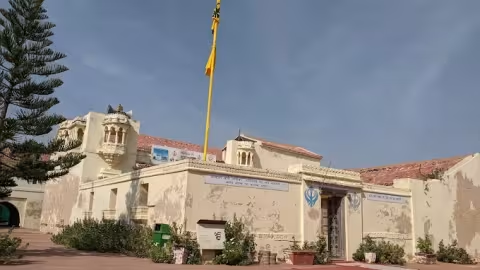
Lakhpat Gurdwara Sahib
History
Lakhpat Gurdwara Sahib or Gurdwara Pehli Patshahi (Gurdwara of The First Master) is a Gurdwara, a place of worship for the Sikhs, located in Lakhpat of Kutch district, Gujarat, India. Guru Nanak on his way to Mecca stayed over in the town during his second (1506-1513) and fourth (1519-1521) missionary journey called Udasis. It is believed that he had visited the site during his fourth journey. The descendants of the host established Gurdwara here in early 19th century. This Gurdwara have his relics like wooden footwear and palkhi (cradle) as well as manuscripts and markings of two important heads of Udasi sect. The site is worshiped by the Udasi sect and initially it was maintained by them. Now it is maintained by local Sikh community and Gurdwara Shri Guru Nanak Singh Sabha of Gandhidham. The Gurdwara is the State Protected Monument (S-GJ-65) by the state archeological department. It has won the UNESCO Asia-Pacific Award in 2004 of Distinction for conservation after the earthquake in 2001